
Marketing Attribution Services: What They Cover and How to Choose
Marketing attribution services explained: what they measure, how attribution models assign credit, the data you need, the limits, and how to pick the right setup.

Marketing Attribution Services: What They Cover and How to Choose
Marketing attribution services connect your ad spend to the leads and revenue it produces. They track the touchpoints a buyer passes through, apply a model that assigns credit to each one, and report which channels and campaigns deserve more budget. The right service for you depends less on software features and more on three things: how clean your tracking is, how long your sales cycle runs, and which decisions the numbers need to support.
This guide explains what these services include, how the main attribution models differ, what data you must have in place, where attribution misleads, and how to choose a provider or setup.
MediaclickTurn Ad Data Into Better DecisionsMediaclick pairs performance-driven advertising with conversion-focused websites to help businesses and municipalities turn online clicks into qualified leads.Explore Mediaclick
TL;DR
Attribution services assign credit for a lead or sale across the ads, clicks and other touchpoints that preceded it, so you can compare channels and shift budget.
The model matters: first-touch and last-touch give 100% of credit to one interaction, while linear, position-based and data-driven models spread it out.
Attribution is only as good as its inputs. Conversion tracking, consistent campaign naming and CRM or call data come before any modeling.
Attribution shows credit, not proof of cause. Pair it with incrementality tests or marketing mix modeling when the budget is large.
For most local, legal and public-sector advertisers, a clean tracking foundation and honest reporting beat an expensive enterprise platform.
Table of Contents
What marketing attribution services actually do
Marketing attribution modeling: how credit gets assigned
The data you need before any model works
Where attribution misleads
Attribution, marketing mix modeling and incrementality testing
How to choose a marketing attribution service
Our perspective
Put measurement to work with Media Click AI
FAQ
Sources
What marketing attribution services actually do
At its core, an attribution service is an analytics service that assigns credit, or calculates influence, for customer interactions that lead to a defined outcome. Adobe describes its own attribution product as a way to quantify the impact of each marketing touchpoint, and lists reporting, budget allocation, campaign optimization, full-funnel analysis and partner evaluation as the uses.
In practice, a service usually covers four layers:
Tracking setup. Tags, pixels, offline conversion imports, call tracking and form tracking, so every meaningful outcome is recorded.
Data consolidation. Pulling ad platform, website analytics and CRM data into one view, with consistent naming for campaigns and channels.
Modeling. Applying one or more attribution models to assign credit.
Reporting and action. Dashboards, recommendations and budget decisions based on what the model shows.
The providers you will meet fall into types rather than one standard offering: software platforms you operate yourself, agencies that build and run the measurement for you, and analytics consultancies that design bespoke models. Software gives you control and a monthly bill. An agency gives you interpretation, which matters because, as the IAB puts it, no measurement method works without careful design, correct implementation and people who can read the results.
Marketing attribution modeling: how credit gets assigned
An attribution model is a set of rules or an algorithm that decides how much credit each touchpoint receives. Google’s definition is useful here: its data-driven approach compares converting and non-converting paths and uses probability changes to distribute fractional credit across touchpoints.
The main model families, as described in Google’s guide to attribution, look like this:
Model | How credit is assigned | Best suited to | Main risk |
|---|---|---|---|
First touch | 100% to the first interaction | Judging which channels create awareness | Ignores everything that closed the deal |
Last touch | 100% to the final interaction | Short, simple sales paths | Overrewards branded search and retargeting |
Linear (even weighting) | Equal share to every touchpoint | Long consideration cycles, teams new to multi-touch | Treats a passing impression like a decisive click |
Position-based (custom) | Chosen weights for introducer, promoter and closer | Teams that know which stages matter most | Weights are a judgment call, not a measurement |
Data-driven (algorithmic) | Learned from the journeys of converters and non-converters | Accounts with enough conversion volume | Needs data volume and is harder to explain |
A few details are worth knowing. With linear attribution, four touchpoints each receive 25%. Nielsen notes that even weighting can suit long consideration cycles where repeated messages matter, and that it is a reasonable starting point for marketers new to multi-touch attribution. The same guide argues that rules giving all credit to the first or last touch can skew decisions, because they fail to measure the middle of the journey.
The practical lesson: run more than one model on the same data and compare. If a channel looks great under last-touch and weak under linear, it is probably closing demand that another channel created. That gap is the insight, and it is exactly what a good attribution service should surface.
A worked example
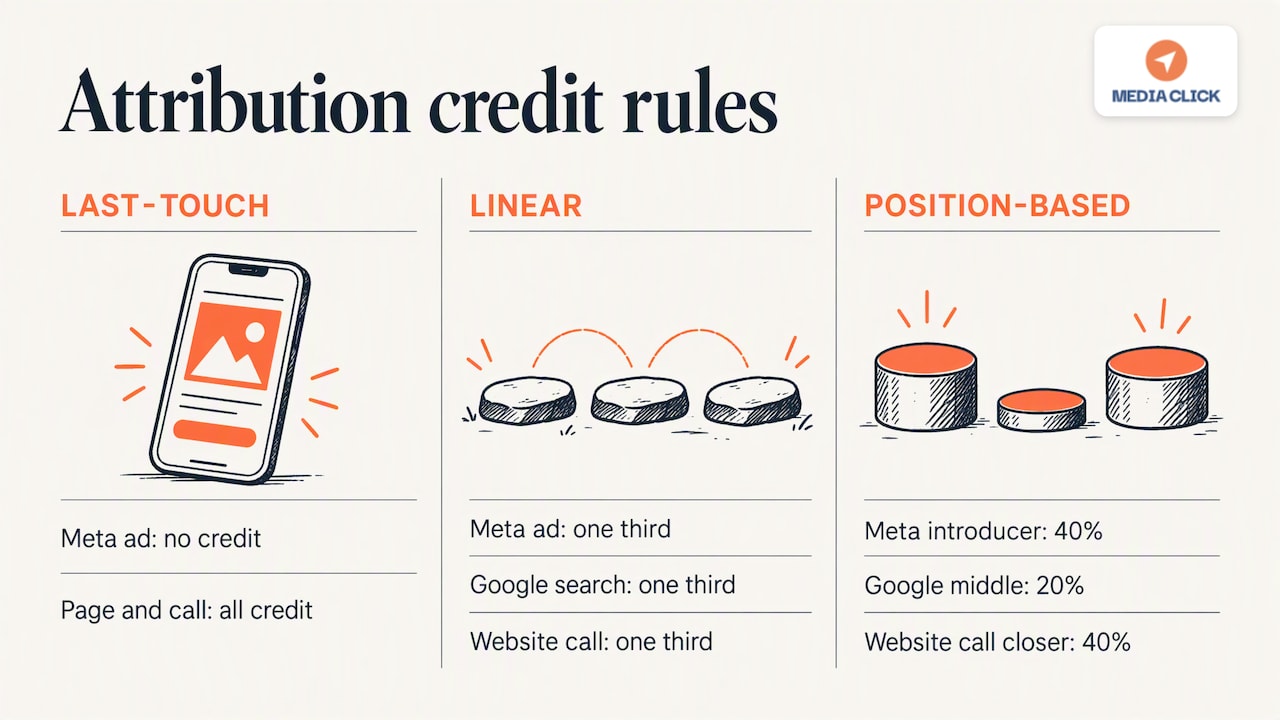
Imagine a law firm lead who sees a Meta ad, later clicks a Google search ad, then calls from a number on the website after reading a practice-area page. Under last-touch, the call and the page get everything and the Meta ad gets nothing. Under linear, each of the three touches gets one third. Under a position-based rule, you might give 40% to the introducer, 40% to the closer and 20% to the middle. None of these is the truth. Each is a lens, and the budget conversation changes depending on which lens you use.
The data you need before any model works
Models do not fix bad inputs. Google’s guidance says implementation needs event data such as impressions, clicks and conversions for each marketing factor included, plus the website outcomes you care about, such as sales, downloads or lead submissions. It also calls for reference data, so records can be grouped by creative, placement and other attributes into reporting categories you can act on.
The IAB adds a cost warning: robust data collection is imperative, and inaccurate or restated data can delay results, reduce model accuracy and create rerun costs.
A workable checklist before you buy any service:
Conversions defined. Decide what counts: a form submission, a booked consultation, a phone call over a set length, a signed engagement.
Platform tracking verified. Our guide to Google Ads conversion tracking walks through setting it up and testing that you can trust it.
Phone leads captured. Many high-value leads call instead of filling out forms. Call tracking ties those calls back to the ads that produced them.
Consistent naming. One naming convention for campaigns, ad sets and UTM parameters across platforms.
CRM outcomes connected. Leads need a status (qualified, won, lost) fed back to the ad data, or you will optimize for cheap leads instead of good ones.
Reporting that people read. See our notes on building Meta ads reports that drive decisions rather than fill a slide deck.
Where attribution misleads
Attribution is useful, but it has well-documented limits, and any service that does not tell you about them is selling certainty it cannot deliver.
Credit is not causation. The IAB and Media Rating Council warn that attribution credit is not automatically causal, and that many models leave out price, promotion, competition, weather and economic conditions.
Bias toward measurable channels. The same guidelines note that attribution values can be biased by data availability, because digital exposure data is easier to get than data from other media.
Access gaps. The IAB points out that mobile and in-app inventory, OTT, walled gardens and non-digital addressable data create access challenges for multi-touch attribution.
Cross-device and consent. One vendor’s documentation says multi-touch attribution can underrepresent view-based channels, struggle to link devices, lose visibility through opt-outs and miss offline purchases unless CRM or point-of-sale data is matched in.
None of this means attribution is not worth doing. It means you should treat its output as a well-informed estimate, check it against business results, and avoid cutting a channel on a single model’s say-so.
Attribution, marketing mix modeling and incrementality testing
These three methods answer different questions, and a mature measurement setup often uses more than one.
Attribution modeling allocates observed or modeled credit across touchpoints, usually for granular, tactical analysis.
Marketing mix modeling (MMM) is a top-down statistical model using historical media-level data to estimate impact against baseline sales, accounting for seasonality and non-media factors, as described in the MRC’s measurement standards.
Incrementality testing uses randomized exposed and holdout groups. The MRC defines incrementality as the causal impact of marketing, isolated from other business factors.
The data demands differ. The IAB says MMM generally needs roughly three years of historical data across media types and KPIs, while multi-touch attribution can be deployed on a campaign basis under suitable tracking conditions. A published decision framework adds that incrementality needs control-group construction or geo-paired matching, and multi-touch attribution needs touch-level signals plus identity resolution where consent permits.
BCG’s view is that the three work best together: MMM for strategic planning, testing for causal evidence and multi-touch attribution for daily optimization. For a small or mid-sized advertiser, that usually translates to a simple order of operations: fix tracking, run attribution, then add a holdout test on your biggest channel once spend justifies it.
How to choose a marketing attribution service
Start from your decisions, not from a feature list. Ask which budget calls the numbers must support in the next twelve months, then match the service to that.
Match the method to your sales cycle
Short, single-channel paths (a local service business running search ads) rarely need algorithmic multi-touch models. Clean conversion tracking and last-touch plus one comparison model will show most of what matters. Long, multi-channel paths, such as legal services, public-sector projects or high-ticket B2B, benefit from seeing the middle of the journey.
Check what it connects to
A service that only reads ad platform data will always flatter the ad platforms. Look for CRM integration, call tracking, offline conversion imports and a way to record lead quality. If you cannot see which leads became clients, you are measuring activity, not growth.
Ask how models are explained
A good provider shows you at least two models side by side, tells you what each one assumes, and states where the data is thin. Be cautious of any pitch that promises the single true number.
Decide who will operate it
Software needs someone on your team to configure, audit and interpret it. If nobody has that time, a managed service that includes setup, reporting and recommendations will deliver more value than a dashboard no one opens.
Weigh cost against ad spend
Measurement should cost a modest fraction of the budget it governs. If your monthly ad spend is small, spend first on tracking and reporting hygiene. Heavier tools make sense as spend, channel count and sales-cycle length grow.
Ask about privacy and consent
Tracking depends on user consent in many regions, and opt-outs reduce visibility. A provider should explain how it handles consent, and what share of conversions it expects to be modeled rather than observed. This matters especially for municipalities and law firms, whose audiences and compliance obligations call for care.
Our perspective
Most attribution problems we see are not model problems. They are setup problems: a form that is not tracked, a phone line with no source data, campaigns named three different ways, and leads that never get a status in the CRM. Fixing those gives you more accurate answers than switching to a more advanced model.
We build measurement around the outcome our clients pay for: qualified leads. That means conversion tracking first, then call and form capture, then reporting that shows cost per qualified lead by channel instead of clicks and impressions. Our analytics and reporting work is designed to give municipalities, law firms and local businesses a view they can act on, with the assumptions stated plainly.
We also believe attribution belongs next to the creative and the website, not apart from them. If a landing page converts poorly, no model will rescue the campaign. Across more than $3.2 million in managed ad spend, our approach has been to connect ad data, site behavior and lead outcomes, and to keep optimizing from what that shows.
the author
Put measurement to work with Media Click AI
If you want attribution that ends in decisions rather than dashboards, we can help. Our analytics and reporting, lead generation and community engagement services are built around tracking what produces qualified leads. We pair that with paid media, web design and brand design, so the ads, the site and the measurement work as one system. Pricing is custom and scoped to each project.

For a sense of the work, see our immigration law campaign that drove 63 leads, or read how we think about local business advertising and what it costs.
FAQ
What is the difference between marketing attribution and marketing attribution modeling?
Attribution is the broader practice of connecting marketing activity to outcomes. Attribution modeling is the specific method inside it: the rules or algorithm that decide how much credit each touchpoint gets. A service typically includes both, plus the tracking and reporting around them.
Which attribution model should a small business start with?
Start with the model your ad platform and analytics tool already offer, and compare it against a simple alternative such as linear. Nielsen describes even weighting as a starting point for those new to multi-touch attribution. Move to data-driven models once you have steady conversion volume.
Can attribution tell me which ads caused a sale?
Not on its own. Attribution assigns credit based on observed touchpoints, and credit is not automatically causation. To estimate causal impact, run an incrementality test with exposed and holdout groups, then use attribution for day-to-day optimization.
Do I need attribution if most of my leads come by phone?
Yes, but you need call tracking first. Without it, phone leads show up as direct or unknown traffic and your ad channels look worse than they are. Connecting calls to campaigns makes any model more reliable.
How long does it take before attribution data is useful?
Basic reporting on tracked conversions can be useful within weeks of verifying your tracking. Marketing mix modeling needs far more history: the IAB cites roughly three years of data. Plan for attribution to sharpen over several months as lead outcomes flow back from your CRM.
Sources
Methods & Models: A Guide to Multi-Touch Attribution, Nielsen
The Essential Guide to Marketing Mix Modeling and Multi-Touch Attribution, IAB
MRC Outcomes and Data Quality Standards, public comment draft