
Meta Ads Strategy: A Practical Framework for Leads in 2026
A clear Meta ads strategy for 2026: campaign structure, objectives, audiences, creative testing, budgets, the learning phase and the metrics that matter.
Meta Ads Strategy: A Practical Framework for Leads in 2026
A good Meta ads strategy comes down to five decisions made in order: the business outcome you want, the objective and conversion event that represent it, a simple campaign structure, a steady supply of fresh creative, and a measurement plan that judges results by leads and revenue instead of clicks. Get those right and most of the tactical settings take care of themselves. Get them wrong and no bid strategy will rescue the account.
This guide walks through each decision the way we approach it for law firms, municipalities and local businesses. It also answers the questions people keep asking: whether $10 a day is enough, what the 3-2-2 method is, and which bid strategy to choose.
MediaclickTurn Ad Strategy Into Qualified LeadsMediaclick combines performance-driven advertising with conversion-focused websites to help law firms and local businesses attract qualified leads.Explore Mediaclick
TL;DR
Start from the business outcome (a signed client, a permit application, a booked call), then pick the Meta objective and conversion event that match it.
Keep the account simple: few campaigns, few ad sets, broad audiences, automatic placements, and several genuinely different creatives.
Protect the learning phase. Every significant edit to targeting, creative, optimization event or bid strategy can restart it, so change things on a schedule, not on impulse.
$10 a day can work for tests and small warm audiences, but it rarely produces enough conversion data for lead generation at speed.
Judge performance by cost per lead, lead quality and return on ad spend, not likes, views or cheap clicks.
Table of Contents
What a Meta ads strategy actually is
Step 1: Start with the outcome, not the objective
Step 2: Keep the structure simple
Step 3: Audiences, placements and the local exception
Step 4: Creative is the main lever
Step 5: Budget, bidding and the learning phase
Step 6: Landing pages decide whether clicks become leads
Step 7: Measure what matters
How this looks for law firms, municipalities and local businesses
Perspective: what we see in the accounts we run
Want help running this for your organization?
FAQ
Sources
What a Meta ads strategy actually is
A Meta ads strategy is a framework that lines up advertising objectives with business goals. It is not a list of hacks. It answers four questions: who you want to reach, what you want them to do, what they will see, and how you will know it worked.
The platform gives you a three-level structure to express those answers. Meta’s own training describes Ads Manager as a system of campaigns, ad sets and ads, with different setup options depending on the objective.
Level | What you decide here | Typical question it answers |
|---|---|---|
Campaign | Objective, buying type, campaign-level budget | What result do we want? |
Ad set | Destination, optimization event, budget and schedule, audience, placements | Who sees the ad, and what is the system optimizing for? |
Ad | Format, image or video, copy, headline, call to action | What will people see and do? |
The split matches Meta’s Traffic Playbook, which places the objective, buying type and campaign budget at the campaign level, and destination, delivery optimization, budget, schedule, audience and placements at the ad-set level. Creative lives in the ad.
Keep that map in your head. Most account problems are a decision made at the wrong level: a goal buried in an ad set name, or an audience fenced in so tightly that delivery has nothing to work with.
Step 1: Start with the outcome, not the objective
Before opening Ads Manager, write down the commercial result in one sentence. For a law firm it might be “qualified consultations for immigration cases.” For a borough it might be “residents using the new online permit page.” For a contractor, “booked estimates in the next 30 days.”
Nielsen’s planning guidance makes the same point: map objectives and events to core business outcomes such as revenue growth, and track events that show real intent instead of superficial engagement. The objective you choose tells the algorithm which result to chase, so it will faithfully chase whatever you point it at, including the wrong thing.
Choosing the objective
Pick the objective that matches the actual goal. As a simple rule, Sales is for purchases and Leads is for signups. In practice:
Leads for consultations, quote requests and contact forms.
Sales when you can pass purchases or paid bookings back to Meta.
Traffic only when visits themselves are the goal, such as a public notice or event page. Meta’s Traffic Playbook recommends a sufficient budget, time to learn and the highest-volume bid strategy for these campaigns.
Engagement rarely for lead generation. It is built for video views, post interactions, messages or follows, and likes and comments seldom predict revenue.
Choosing the conversion event
The event is the signal Meta optimizes toward. A submitted form is better than a page view. A booked call is better than a submitted form, if you can send it back. The deeper the event, the more valuable the signal, but the fewer events you will collect, and that tension drives budget decisions later.
A practical way to resolve it: optimize for the deepest event that still fires often enough to feed learning. If booked calls only happen a few times a month, optimize for qualified form submissions and report on calls separately in your CRM.
Step 2: Keep the structure simple
The most common mistake in a struggling account is fragmentation: a dozen campaigns, each with several narrow ad sets, each spending a few dollars. Delivery needs data, and splitting budget splits data.
A lean structure that works for most B2B services and local lead generation:
One prospecting campaign with the Leads or Sales objective, one to three ad sets, and a handful of ads in each.
One retargeting campaign for website visitors, video viewers and past leads, with a separate, smaller budget.
One testing campaign (optional) where new creative is trialed before it enters the main campaign.
The testing approach has a name in practitioner circles: a sandbox. Experimental ads run at a fixed ad-set budget (ABO), and winners graduate to a scaled campaign using campaign budget optimization (CBO). It keeps experiments from starving your best performers and keeps proven ads from being buried by unproven ones.
Step 3: Audiences, placements and the local exception
Meta’s delivery system has become better at finding likely responders than hand-built interest stacks. The Traffic Playbook’s guidance is to keep audiences broad enough for delivery to find people who respond, while noting that local businesses may need smaller audiences.
That caveat matters for most of our clients. A municipality can only serve its residents. A law firm licensed in one state can only take clients in that state. Geography is a real constraint, so set it deliberately and then let the rest stay open:
Location: be exact. Use the borough, county or state you serve, and review whether “people living in” or “people recently in” the location fits your goal.
Age and gender: restrict only when the service truly requires it.
Interests: use them as a light suggestion, not a wall.
Custom audiences: upload customer or subscriber lists where you have permission, and use them for retargeting and as a quality reference.
Placements
The same playbook advises selecting Advantage+ placements, then previewing how the ad appears in each placement. Automatic placement lets delivery find the cheapest results across Facebook, Instagram and Meta’s other surfaces. Your job is to make sure the creative looks right in each: vertical video for Stories and Reels, a safe zone for text, a readable crop for the feed.
Rules for sensitive categories
Some advertisers face extra rules. Municipalities running civic messages should know that Meta has restrictions on political, electoral and social issue ads; in the EU, these ads are no longer allowed as of October 6, 2025 because of regional transparency and targeting regulations. In the US, check Meta’s current policies and authorization requirements before launching anything that touches public policy or an election. Law firms should likewise confirm the platform’s and their state bar’s advertising rules before publishing claims.
Step 4: Creative is the main lever
With targeting increasingly automated, creative does most of the targeting. A different hook reaches a different person. This is why the best accounts treat creative as a production line, not a one-off.
Guidance from the Traffic Playbook is simple and holds up: choose the format and media at the ad level, keep text short and value-focused, check the destination URL and match the call to action to the desired action.
What to put in each ad
One offer. A free case review, a permit portal, a quote in 24 hours. Not three.
A hook in the first line or first two seconds. Name the problem the viewer has.
Proof. A real number, a recognizable local name, a short testimonial you are allowed to use.
A call to action that matches the page. If the button says “Book now,” the landing page should show a booking form above the fold.
The 3-2-2 method
The 3-2-2 method is a creative testing framework: three visuals, two primary texts and two headlines, loaded into a dynamic creative ad set. Meta mixes the elements and shows which combinations work, so you do not have to build dozens of manual ads. It is a good way to get early signal on which angle resonates.

Two cautions. First, the method tells you which combination performed, not why, so make your three visuals genuinely different (a person, a screenshot, a short video) instead of three crops of the same photo. Second, treat the result as a direction. Take the winning elements and build proper standalone ads around them.
A simple creative cadence
Cadence | Action |
|---|---|
Weekly | Review spend, cost per lead and lead quality by ad. Pause clear losers. |
Every two to three weeks | Introduce two to four new ads with a new hook or format. |
Monthly | Review which angles win. Brief the next batch. |
Quarterly | Refresh the offer, the landing page and the proof points. |
Step 5: Budget, bidding and the learning phase
When you launch or significantly edit an ad set, Meta enters a learning phase in which it explores how to deliver the ad set and performance is less stable. Meta’s delivery guidance says the system needs around 50 optimized conversion events for each ad set before it can exit that phase, and that is why consolidating ad sets is recommended.
The practical consequences:
Do not edit constantly. Changes to targeting, creative, the optimization event or bid strategy can restart learning. Batch your changes and make them once or twice a week at most.
Do the math before launch. If a lead costs you $40 and you need roughly 50 events, an ad set needs around $2,000 of spend to exit learning. If that is out of reach, optimize for a shallower event or run fewer ad sets.
Do not judge on day two. Early numbers are noisy.
What is the best bid strategy?
For most lead generation accounts, the answer is to start with the default, highest-volume approach and let the system spend the budget. It is also what Meta recommends for traffic campaigns in the Traffic Playbook, alongside Advantage campaign budget. Move to cost caps or bid controls only once you have stable data and a clear target cost per lead. Applying a cap too early often strangles delivery.
Is $10 a day enough?
Sometimes. At $10 a day you can test an offer, build awareness in a small area, or retarget a small warm audience. Where the objective is conversion-focused and needs volume to exit the learning phase, it usually is not enough for quick results, and scaling is slow. If you only have a small budget, one practitioner guide for small budgets recommends one campaign, one ad set and one or two ads at a time so the data is not diluted. The same arithmetic as above applies: divide your budget by your likely cost per lead and see how many events a month you can realistically collect.
Step 6: Landing pages decide whether clicks become leads
Meta can deliver the click. It cannot fix a page that is slow, confusing or off-message. For lead generation, the destination matters as much as the ad. Two routes exist: an in-app instant form, which is fast and low-friction, or a landing page on your own site, which gives you more control over qualification and tracking. Instant forms often produce more leads at lower cost, but those leads can be less committed, so test both and compare on qualified leads, not form fills.
Whatever you choose, make the page match the ad: the same offer, the same words, one clear action, a form that asks only what you need, and mobile loading that feels instant. If you are building or rebuilding that page, our notes on design that converts cover what we look at first. Our work page 6,252 Views to 124 Leads shows what a tight match between ad and page can do on another channel.
Step 7: Measure what matters
A robust measurement plan has defined objectives, mapped KPIs, identified data sources and a consistent reporting cadence. Nielsen’s guidance goes further and recommends measuring outcomes through lead conversions, cost per lead, ROAS, long-term ROI and brand equity, not views, clicks or likes.
A workable scorecard for a lead generation account:
Metric | Why it matters | Where to read it |
|---|---|---|
Cost per lead | Efficiency of acquisition | Ads Manager |
Qualified lead rate | Whether leads fit your criteria | CRM or intake sheet |
Cost per qualified lead | The number that actually pays the bills | Combine both |
ROAS or revenue per lead | Return on spend | CRM plus billing |
Frequency and creative fatigue | Signals when to refresh ads | Ads Manager |
Lead response time | Slow follow-up wastes good leads | CRM |
The most valuable habit is closing the loop. Ask your intake team or office which leads were real, and feed that back into creative and targeting decisions. A campaign with a higher cost per lead and a much higher qualified rate is the better campaign.
How this looks for law firms, municipalities and local businesses
The framework is the same, but the emphasis shifts.
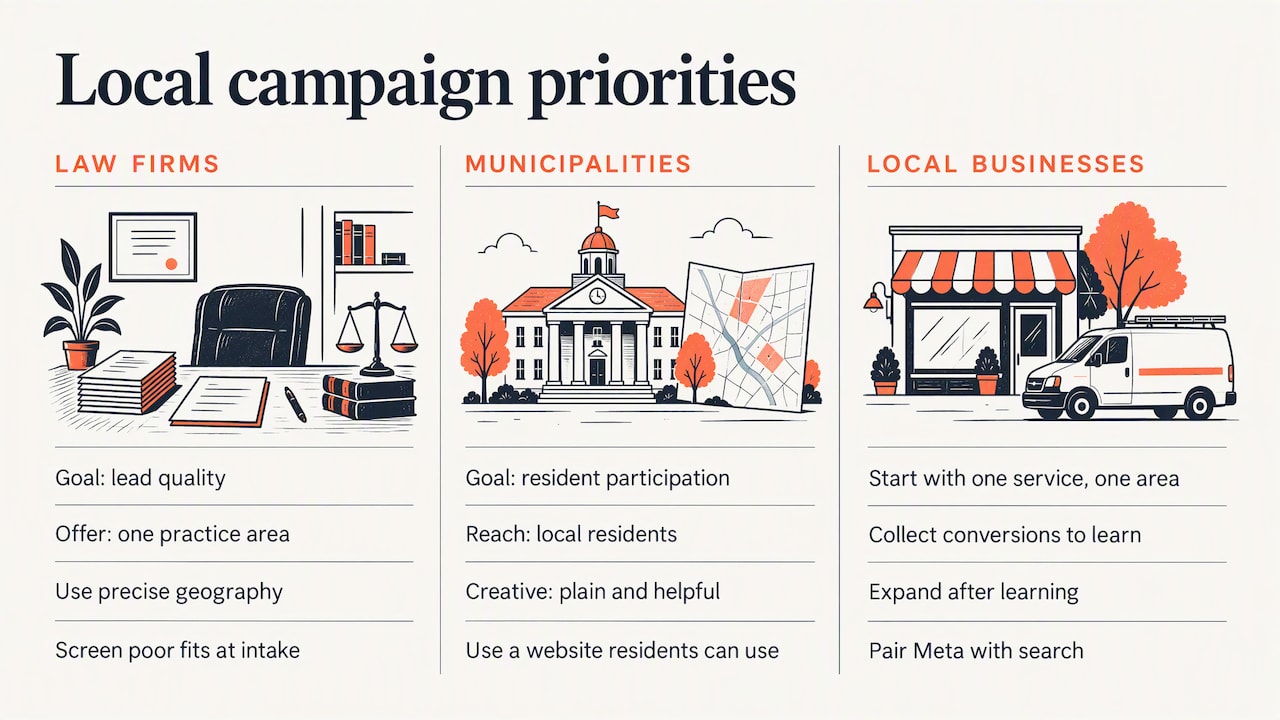
Law firms. Lead quality is the whole game. Use a specific offer (a case evaluation for one practice area), geographic precision, and intake questions that screen out poor fits. Follow up fast. Our immigration law campaign driving 63 leads is an example of a focused practice-area campaign.
Municipalities. The goal is usually participation, not sales: residents using a service, attending a meeting, or finding information. Reach is local and creative should be plain and helpful. Pair it with a website residents can actually use; see how we approached the Borough of Englewood Cliffs civic website.
Local and professional businesses. Start with one service and one geography, collect enough conversions to learn, then expand. Combining Meta with search often works well, because social creates demand and search captures it. If you are weighing the search side, our guide to what Google Ads costs a small business is a good companion, and our piece on why paid media matters explains how the channels fit together.
Perspective: what we see in the accounts we run
Across the campaigns we manage, which have covered more than $3.2 million in ad spend, the pattern is consistent: accounts rarely fail because of a missing targeting trick. They fail because the goal was vague, the event being optimized was shallow, or the landing page could not turn attention into an inquiry.
Our view is that strategy is mostly editing. We cut campaigns, merge ad sets, retire tired ads and keep the question “did this produce a qualified lead?” in front of everyone. We pair advertising with conversion-focused website work because the click is only half the job, and we report in plain numbers so clients can see what spend turned into. For municipalities and law firms in particular, where trust and accuracy matter more than flash, we favor clear offers, accessible design and steady, measured optimization over aggressive scaling.
— User
Want help running this for your organization?
If you would rather have a team build the structure, creative and landing pages together, that is what we do. We combine paid media, conversion-focused web design, branding and reporting for law firms, municipalities and businesses that need qualified leads. Pricing is scoped per project, so the quickest route is to look at the services we offer and tell us what you are trying to achieve.
FAQ
What is the best strategy for Meta ads?
Start with a clear business outcome, choose the matching objective and conversion event, and keep the account simple with broad audiences and automatic placements. Then feed it a steady stream of different creative and judge results by qualified leads and revenue. There is no single trick; the discipline of testing and editing on a schedule is the strategy.
What is the 3-2-2 method of Facebook ads?
It is a creative testing setup with three visuals, two primary texts and two headlines inside a dynamic creative ad set. Meta mixes the elements automatically to show which combination performs best. Use it to find promising angles, then build standalone ads from the winners.
Is $10 a day enough for Facebook ads?
It can be enough for a small test, a local awareness push or retargeting a small warm audience. It is usually not enough for conversion-focused campaigns that need volume to leave the learning phase. Keep the structure to one campaign and one ad set if you start there.
What is the best bid strategy for Meta ads?
Most advertisers do best starting with the highest-volume default and letting delivery spend the budget, which is also what Meta recommends for traffic campaigns. Consider cost caps only after you have stable results and a known target cost per lead.