
Local Business Advertising: What Works and What It Costs
A practical guide to local business advertising in the US: where to spend first, how to measure leads, and how to avoid wasting budget on clicks that never call.
Local Business Advertising: What Works and What It Costs
The best local business advertising puts you in front of people who are already searching for what you sell, in the area you serve, at the moment they are ready to call or visit. For most US businesses that means three things in order: a complete Google Business Profile, a small, tightly targeted paid search budget, and a website that turns the click into a call or a form. Everything else, from flyers to sponsorships, works best as support.
This guide walks through where to put your first dollar, how the main channels differ, and how to tell whether the money is producing customers or just clicks.
Mediaclickmediaclick.aiTurn Local Clicks Into Qualified LeadsMediaclick combines targeted advertising with conversion-focused websites to help local businesses attract leads and communicate clearly with their audiences.Explore local advertising solutions
TL;DR
Start with free visibility: a verified, complete, actively managed Google Business Profile. Strong profiles convert about three times better than weak ones, according to one 2025 report.
Add paid search or Local Services Ads next, limited to your service area, because that is where buyers with intent are.
Use social, Nextdoor and offline tactics to build familiarity, not to replace search.
Judge every channel by qualified leads and cost per lead, not impressions or clicks.
A fast, clear landing page decides whether ad spend turns into revenue.
Table of Contents
Why local advertising is a different game
Step one: fix your Google Business Profile before you pay for anything
Step two: paid search and Local Services Ads
Step three: directories, social and neighborhood platforms
What good measurement looks like
Perspective: why the landing page is where most local budgets leak
Special cases: law firms and municipalities
Where to start this month
When to bring in help
FAQ
Sources
Why local advertising is a different game
A national brand buys reach. A local business buys proximity and trust. Your customer base lives within a few miles or inside a defined service area, so every impression outside it is wasted money.
Buyers also check you out before they show up. A consumer report on local search found that 91% of consumers search before visiting a business, and the same research reports that 85% visit within a week of searching. In other words, a search is often the last step before a purchase, not the first.
That changes how you should spend. Advertising that appears when someone types “emergency plumber near me” or “immigration lawyer in Jersey City” is worth more per dollar than a broad awareness campaign, because the decision is already half made.
Step one: fix your Google Business Profile before you pay for anything
Paid ads send people to look at you. If what they find is thin, they leave and your ad money is gone. Your Google Business Profile is the first thing many of them will see.
The Weblish visibility report, published in January 2026, found that weak profiles convert about 2.1% of views into calls or direction requests, against 6.2% for strong ones. It defines strong as roughly 4.5 stars or more, 50 or more reviews and complete information. The report estimates the gap at around $24,000 a year for a typical local business with 600 monthly profile views. That is a vendor-published estimate, so treat it as an illustration of direction, not a promise. The direction is still sensible: complete profiles get more action.
A short checklist:
Verify the business. Google requires it before you can set up an ad campaign from your Business Profile.
Complete every field: categories, hours, service area, phone, website, services and photos.
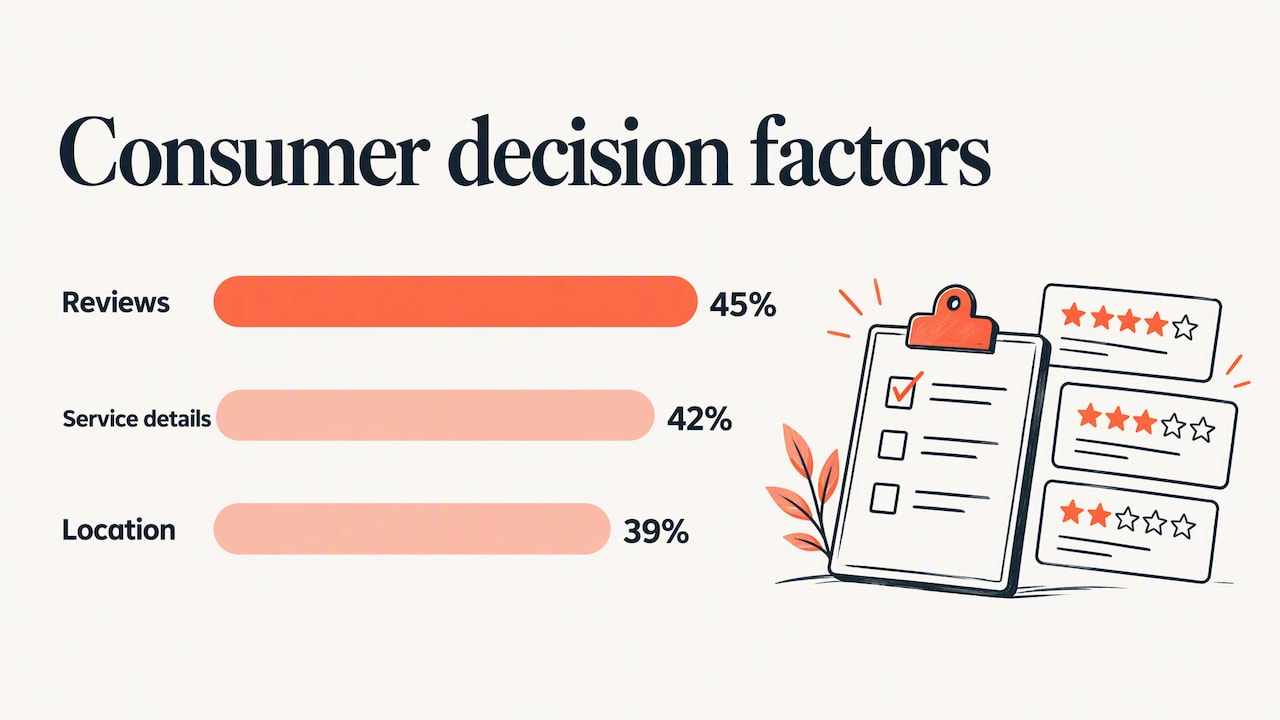
Ask for reviews after every job, and answer all of them, the negative ones included. In the consumer research, 45% of respondents said reviews were the most important factor in their decision, ahead of service details (42%) and location (39%).
Update weekly. Posts, holiday hours, new photos and current pricing signal that you are open and active.
None of this costs ad dollars, and it raises the return on every paid channel that follows.
Step two: paid search and Local Services Ads
There are two main ways to buy Google traffic for a local business, and they work differently.
Local Services Ads
Local Services Ads show your business at the top of results with a Google Verified badge, and Google says you pay for customers, not clicks. They suit service businesses such as home services and some professional categories. Eligibility depends on passing Google’s screening and verification process, which varies by category and location and can include background and registration checks. Budget extra time for it before you plan a launch date.
Search and Maps ads
Standard Google Ads campaigns give you more control over keywords, copy and landing pages. Google’s Local Ads documentation describes goals such as store visits, calls and directions for businesses with a physical location or service area. You can also show search ads on Google Maps, which matters when people are navigating or comparing nearby options on their phones.
Which one fits you
Situation | Likely best first move |
|---|---|
Home service or trade, wants phone calls | Local Services Ads, plus a strong profile |
Law firm, clinic or other regulated service | Search ads with tight keywords, plus careful landing pages |
Retail or restaurant with foot traffic | Maps and local search ads, plus profile posts |
Municipality or public body communicating with residents | Targeted awareness and a clear website, not lead ads |
New business with a small budget | Profile first, then a small search test |
If you want to know what to budget, our breakdown of what Google Ads costs a small business covers the variables that move the number. Costs vary a lot by industry and city, so any single average should be read with suspicion, including ours.
Step three: directories, social and neighborhood platforms
Once search is covered, add channels that build recognition.
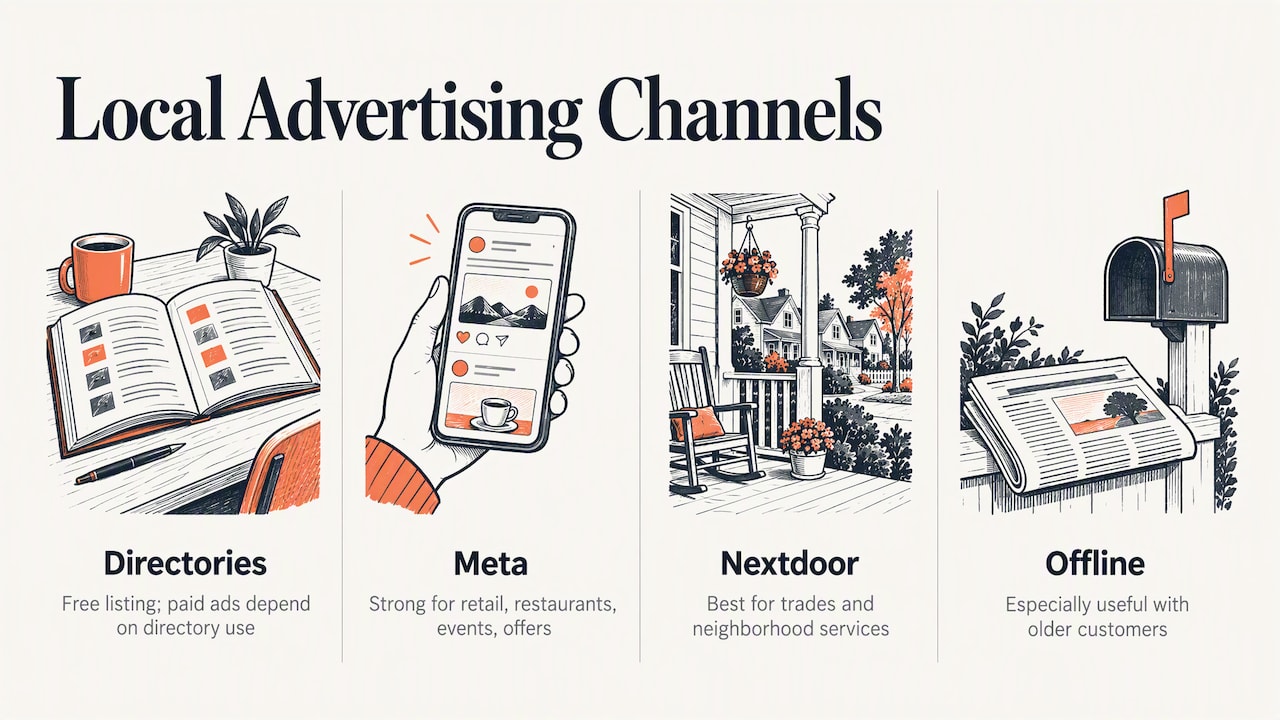
Review and directory sites. Yelp and similar directories let you create a listing for free and offer paid promotion on top. Yelp’s own guide to where to advertise a small business online is a reasonable overview of the options. Whether paid placement pays off depends on whether your customers actually use that directory, so check where your existing customers say they found you.
Meta platforms. Facebook and Instagram let you target by location and interest. They are strong for retail, restaurants, events and offers, and weaker when the buyer has an urgent need and goes straight to search. Meta also provides guidance for promoting a local business on Facebook, Instagram and WhatsApp.
Nextdoor. The platform lets businesses claim a business page and post for free to nearby neighbors, with paid ads available. It works best for trades and neighborhood services where word of mouth already matters.
Offline. Local newspapers, direct mail, signage and sponsoring a youth sports team still work for some businesses, especially those with an older customer base. Track them with a dedicated phone number or a unique offer code, or you will never know.
What good measurement looks like
Clicks are cheap to count and easy to misread. A campaign with thousands of clicks and no calls is failing, and a campaign with 40 clicks and 6 booked jobs is working.
Track these, in this order:
Qualified leads: calls that last long enough to be real, form submissions that match your service and area.
Cost per qualified lead: spend divided by qualified leads, per channel.
Close rate: the share of leads that become customers. This is often a sales problem, not an ad problem.
Revenue per customer and return on ad spend: the number that decides whether to scale.
A worked example. You spend $1,500 in a month and get 30 qualified leads. Cost per lead is $50. If you close 4 in 10 and the average job is $900, you win 12 customers and bring in $10,800, about 7 times your spend. Change any one variable and the picture changes: at a 20% close rate the same campaign returns about 3.6 times. Know all four numbers before deciding that an ad channel is expensive.
Set up call tracking and conversion tracking from day one. If your agency or freelancer cannot show you leads by campaign every month, ask why.
Perspective: why the landing page is where most local budgets leak
We run paid media and build websites for municipalities, law firms and local businesses, and we have managed more than $3.2 million in ad spend. The pattern we see most often is not a bad ad. It is a good ad sending someone to a page that does not answer their question in the first five seconds.
Three habits separate campaigns that produce leads from campaigns that produce reports:
One ad, one promise, one page. A search for a specific service should land on a page about that service, with the phone number and form visible without scrolling.
Reporting you can read. Spend, qualified leads, cost per lead and what we changed this month. Nothing that needs a glossary.
Design that reflects who is reading. A law firm page needs credibility and a calm intake form. A borough site needs clear paths to services and notices. A contractor needs a tap-to-call button. We design each differently.
You can see this in practice in our case of 6,252 views turned into 124 leads, and in a law campaign that drove 63 leads. For public bodies, our civic website and brand modernization for the Borough of Englewood Cliffs shows how a website can serve residents first.
— User
Special cases: law firms and municipalities
Law firms
Lawyer advertising is regulated at the state level, and most states base their rules on the ABA Model Rules of Professional Conduct, which broadly bar false or misleading communications. Check your own state bar’s rules before you publish claims about results or credentials, and have your ethics counsel review the copy. If you claim your site is accessible or “ADA-compliant”, be ready to substantiate it. Accessibility guidance for law firms notes that HTTPS security is not the same as accessibility, and that intake forms, videos and PDFs need to work with screen readers and keyboards.
Municipalities
A town or borough does not chase leads in the same way, but it still competes for attention. Residents look for permits, meeting schedules and payment portals, and they search for them. A clear, current website and a verified profile for each public facility save staff time and phone calls. Paid media here is typically used for specific campaigns, such as registration drives, local events and public notices, targeted by geography.
Where to start this month
A practical order for the next 30 days:
Week 1: claim and verify your Business Profile, complete every field, add current photos, answer every existing review.
Week 2: set up call and form tracking. Check your website loads quickly on a phone and the phone number is a tap-to-call link.
Week 3: launch one narrow campaign, either Local Services Ads if you qualify or a search campaign limited to your service area and your two most profitable services.
Week 4: review the numbers. Cut what produced clicks without leads, and put that money into what produced calls.
Resist launching five channels at once. You will not have enough data to learn from any of them.
When to bring in help
You can do much of this yourself if your budget is small and your time is available. Outside help makes sense when your spend grows, when your website is the bottleneck, or when you need reporting you can trust.
Our services cover Google and Meta ads, conversion-focused web design, brand design, analytics and reporting, and community engagement, built around qualified leads. We price per project scope, so there is no published rate card. If you would like a plan for your area and category, start from our homepage and tell us what you sell and where. You can also browse our work first.
If you want a primer before talking to anyone, read why paid media matters.
FAQ
How much should a local business spend on advertising?
There is no honest universal figure. Work backwards from the numbers: how many customers you want, your close rate and your cost per lead. Start with a small test budget on one channel, then scale what returns more than it costs.
Is Google Business Profile advertising free?
The profile itself is free, but you must verify the business before you can run an ad campaign from it. Paid campaigns are separate and are billed through Google Ads. A complete free profile still earns calls without any ad spend.
Are Local Services Ads better than regular Google Ads?
Neither is better in every case. Local Services Ads are built around calls and a verification badge, and are limited to eligible categories. Standard search ads give more control over keywords and landing pages, and fit categories where Local Services Ads are not offered.
Does offline advertising still work for local businesses?
Yes, for some. Direct mail, signage and sponsorships can work when your customers are older or very neighborhood-bound. Give each a tracking number or offer code, or you cannot compare it with online channels.
Sources
Weblish visibility report on Google Business Profiles (EIN Presswire, January 2026)
Advertise your business on Google, Google Business Profile Help