
Brand Strategy Services: What They Include and What They Cost
What brand strategy services cover, how an agency works stage by stage, what you receive, what drives the fee, and how to judge whether the work paid off.

Brand Strategy Services: What They Include and What They Cost
Brand strategy services help an organization decide what it stands for, who it serves and why people should choose it, then turn those decisions into rules the whole team can follow. A good engagement ends with a written positioning, a messaging framework and a plan for measuring results, not just a new logo. This guide explains what an agency or consultant actually does, what you should receive, what shapes the fee, and how to tell whether the work is paying off.
Mediaclickmediaclick.aiMake Your Brand Clear OnlineMediaclick combines strategic branding with conversion-focused websites and advertising to help organizations communicate their offerings and engage audiences.Explore Mediaclick
TL;DR
Brand strategy is the thinking behind the brand: audience, positioning, promise, voice. Visual identity is how that thinking looks.
A typical engagement runs through research, positioning, messaging, an identity brief and a rollout plan, with written deliverables at each stage.
Fees depend on scope, research depth, the number of audiences and how much implementation is included. Ask for a scoped proposal, not a flat “package” price.
Judge the work with measures set before it starts: awareness, lead quality, revenue, margin and employee engagement.
Strategy only pays off when it reaches the website, the ads and the front desk. Pick a partner who can carry it that far.
Table of Contents
What brand strategy services actually cover
Why organizations pay for brand strategy
What a brand strategy agency does, stage by stage
What you should receive at the end
The seven branding strategies you will hear about
What brand strategy services cost
How to tell whether the strategy is working
How to choose a brand strategy partner
Our perspective: strategy has to survive contact with the website
Where Media Click AI fits
FAQ
Sources
What brand strategy services actually cover
Brand strategy is the set of decisions that define how an organization wants to be known and how it will earn that reputation. Branding, in the everyday sense, is the broader practice of expressing those decisions. Visual identity (logo, colors, typography) is one output of it.
Academic work draws a useful line here. A peer-reviewed article in Marketing Theory separates brand identity, which the owner constructs and manages, from brand image, which is how actual and potential buyers perceive the brand. Its argument explains why strategy cannot be reduced to a logo: management has to connect the identity the owner intends with the image the audience actually holds.
In practice, brand strategy services usually cover:
Audience definition. Who you are for, and who you are not for.
Competitive and category analysis. Where similar organizations cluster and where there is room to be different.
Positioning. The specific place you want to hold in the mind of your audience.
Brand promise and proof points. What you commit to, and the evidence that backs it.
Messaging and voice. How you talk about yourself in headlines, ads, emails and conversations.
Measurement. The indicators that tell you whether the strategy is working.
Strategy, identity and marketing: where one ends and the next begins
The three get blended on agency sites, which is where buyers get confused.
Layer | Question it answers | Typical output |
|---|---|---|
Brand strategy | Who are we for, and why us? | Positioning, promise, messaging framework |
Brand identity | How do we look and sound? | Logo, color, type, voice guidelines |
Marketing | How do we reach people now? | Website, ads, content, campaigns |
Skipping the first layer is the most common and most expensive mistake. You can design a handsome identity and run well-built ads, and still get weak results if nobody decided what the organization should be known for.
Why organizations pay for brand strategy
The commercial reason is risk. Planning guidance from a brand consultancy notes that strategic planning for brand management can mitigate risk by rigorously assessing the internal and external environment before money is committed. In plain terms: you test your assumptions on paper before you test them on a website, a billboard or a $20,000 ad budget.
Typical triggers include:
A new or changed offering. A law firm adds a practice area. A business enters a second market.
A merger, a leadership change or a reputation problem.
Marketing that works inconsistently. Different channels say different things, and leads are poorly matched to what you sell.
A website rebuild. Before a site is redesigned, the organization needs to know what the site must say and to whom.
A public institution that needs to be understood. Municipalities have residents, businesses, visitors and employees to address, often through a site and a seal that have not been revisited in years.
What a brand strategy agency does, stage by stage
Processes differ by firm, but the sequence is consistent because each step depends on the one before it.
1. Discovery and research
The agency interviews leadership and staff, reviews existing materials and analytics, and studies competitors. For many organizations the most valuable input is the customer: who bought, why, what nearly stopped them and what words they used. Search data and ad performance are a good, cheap source of that language.
2. Audit and diagnosis
The team compares how you see yourself with how the market sees you. That is the identity versus image gap described above. The output is a short written diagnosis: what is working, what contradicts itself and what is missing.
3. Positioning
This is the core decision. A positioning statement names the audience, the category you compete in, the main benefit and the reason to believe it. Good ones are specific enough that a competitor could not sign their name to them.
4. Messaging framework
Positioning becomes usable language: a headline, a short description, three or four supporting messages with proof, and guidance on tone. A framework like this is what lets a web designer, an ad writer and a receptionist say the same thing.
5. Identity brief and creative direction
If visual work follows, the strategy becomes a brief: the feelings the identity must convey, the audiences it must work for and the places it will appear.
6. Rollout and measurement plan
The last stage maps the strategy to touchpoints (website, ads, forms, signage, email, internal communication) and sets the measures you will watch. More on those below.
What you should receive at the end
Ask for deliverables in writing before you sign. A reasonable list for a strategy engagement:
A research summary with the main findings, not just a slide of logos.
Audience profiles or segments, with the needs that drive their choices.
A competitive map showing where you sit and where space exists.
A positioning statement and a brand promise.
A messaging framework with proof points and example copy.
Voice and tone guidance.
A rollout plan with priorities and owners.
A measurement plan with baselines.
If a proposal lists only logo files, color codes and a style PDF, you are buying identity design. That can be a fine purchase, but it is not strategy and should not be priced as if it were.
The seven branding strategies you will hear about
People searching this topic often ask about “the seven most common branding strategies.” There is no official list, and agencies each draw it differently. These are the approaches that come up most often, with the situation where each tends to fit:
Approach | Core idea | When it tends to fit |
|---|---|---|
Personal or founder-led branding | The brand is a person’s credibility | Solo practitioners, small law firms, consultants |
Corporate or master branding | One name covers everything | Organizations with related services under one umbrella |
Product or service branding | Each offer has its own identity | Distinct lines aimed at different buyers |
Cause or community-led branding | The brand is anchored in a purpose or place | Local governments, nonprofits, locally rooted businesses |
Cost-leadership positioning | Be the obvious low-price choice | Commodity categories with scale advantages |
Premium or differentiation positioning | Be clearly better or different | Specialist services, expertise-heavy fields |
Rebranding or repositioning | Change what the brand stands for | Mergers, outgrown identities, reputation resets |
The label matters less than the fit. The question is which of these your audience would actually reward, and whether you can deliver on it every day.
Is rebranding risky?
It can be. A rebrand changes what people recognize, so the risks are lost familiarity, inconsistent rollout and a cost that overshoots because the strategy was not settled first. The way to lower the risk is the order of work: diagnose first, decide what to keep, and change only what the research says is holding you back. A refresh of the visual identity with the positioning intact is a much smaller bet than a full repositioning.
What brand strategy services cost
Published ranges vary widely, and many come from agencies marketing their own packages, so treat any single number with suspicion. What reliably drives the fee:
Scope of research. Stakeholder interviews and desk research are modest. Primary customer research, surveys and testing add time.
Number of audiences and offerings. A single-service firm is simpler than a municipality with several resident and business audiences.
Seniority of the team. Strategy led by a senior consultant costs more per hour than work delegated down.
Deliverable depth. A one-page positioning is not the same as a full messaging system with example copy.
Implementation. Strategy alone is cheaper than strategy plus website, ads and rollout support.
Timeline. Compressed schedules usually cost more.
The most useful habit is to ask each bidder for the same thing: a scoped proposal that names the stages, deliverables, number of revision rounds and what is out of scope. Compare those, not hourly rates. If you are budgeting for the whole effort, including advertising, our guide to what local business advertising works and costs helps you plan the media side.
How to tell whether the strategy is working
The answer should be agreed before work starts. The same planning guidance lists measures an organization can use: market share, revenue, margin or profit, employee engagement, awareness, distribution and brand-equity measures such as attitudes, chosen to suit the brand and its competitive set. Its author also stresses that a strategy with a clear measurement component is vital for aligning brand growth with overall company objectives.
For a law firm, that might mean cost per qualified consultation and the share of inquiries in the right practice area. For a municipality, it could be completed online service requests, newsletter sign-ups and resident survey responses. For a business, think branded search volume, lead quality and close rate. Record a baseline in month zero, or you will have nothing to compare against in month twelve.
How to choose a brand strategy partner
Use these criteria to compare proposals:
Do they start with questions, not logos? A real process opens with research and interviews.
Can they show strategy turned into results? Look for case studies that connect decisions to outcomes such as leads or conversions, not just attractive visuals.
Do they understand your sector? Legal advertising and public-sector communication have rules and sensitivities that a generalist may miss.
Will the strategy be carried through? The gap between a strategy deck and a working website is where most value leaks away.
Is reporting transparent? You should see the numbers, in plain language, on a regular schedule.
Are deliverables and ownership clear? You should own the documents and assets you paid for.
Our perspective: strategy has to survive contact with the website
Most brand strategy fails in the handoff. A positioning document sits in a folder while the website still says what it said three years ago and the ads promise something else. We have seen that gap often enough that we build our work around closing it.
Our view is simple. A brand is a promise, and the places people meet it are the website, the ad, the form and the follow-up. So we treat strategy, design and media as one connected job. We start from what the audience is searching for and how they respond, we shape the message and the design around that, and we measure what happens. Across our client work we have managed more than $3.2 million in ad spend, and one of the results we point to is a 10x return on ad spend for a client. Those numbers come from testing and continuous optimization, which only works when the message being tested is clear.
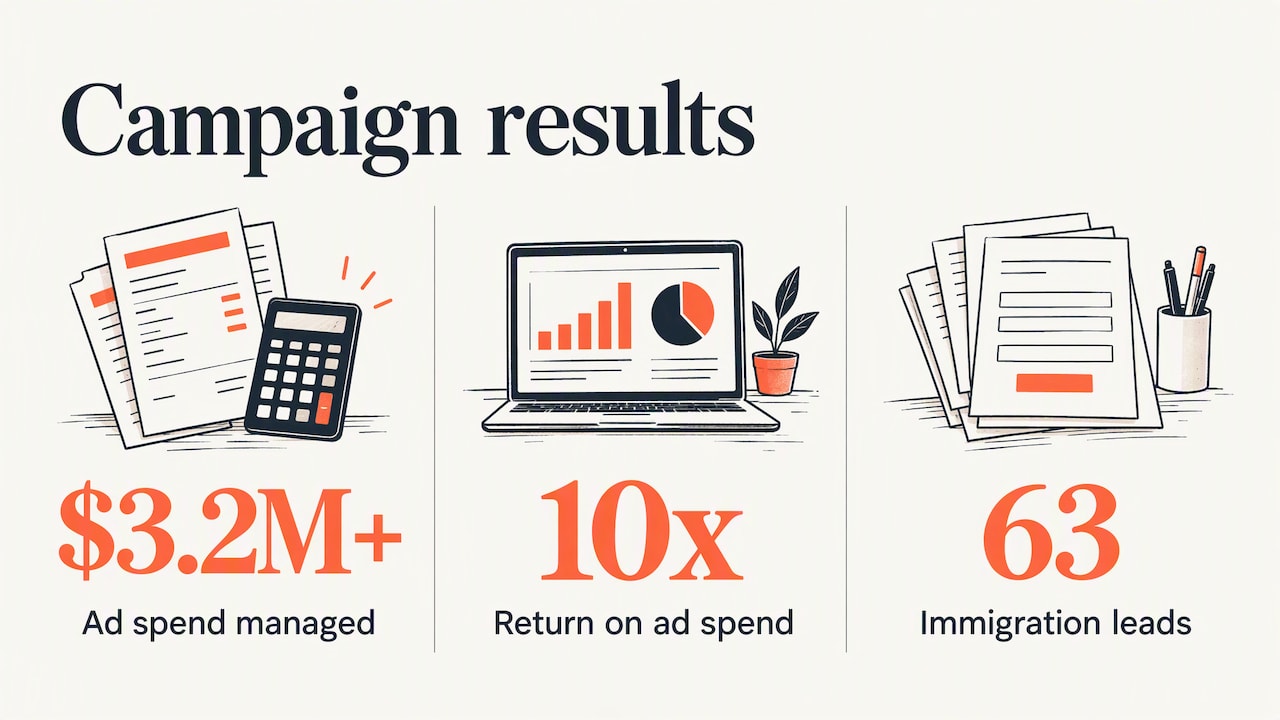
For municipalities, we add community engagement and digital accessibility to the brief, because a public brand is built on being understood and being usable by every resident. For law firms, we focus on qualified leads, not raw clicks: a campaign that brought in 63 leads for an immigration practice is described on our immigration law case page.
If you take one thing from us, make it this: do not buy a brand strategy you cannot see on your homepage within weeks.
— the author
Where Media Click AI fits
We are a performance-driven agency. Our services cover web design, brand design, paid media on Google and Meta, analytics and reporting, community engagement and lead generation, for municipalities, law firms and businesses. That means the positioning work and the pages and campaigns that carry it can sit under one roof, with reporting that shows what each is doing. Pricing is custom and set per project scope and deliverables.
See the full list on our services page, and the results behind it on our work. For a public-sector example, the Englewood Cliffs civic website and brand modernization shows how identity and site structure were reworked together.
If you are weighing a brand project, a short conversation about scope is the fastest way to a proposal. Start from our homepage and tell us what you need to achieve. For more on the design side of the question, read what your brand needs.
FAQ
How much does a brand strategist cost?
It depends on whether you hire a freelancer, a consultant or an agency, and on how much research and implementation is included. Salary and rate figures vary by city, experience and employer, so ask for a scoped proposal and compare deliverables rather than hourly rates alone. Our own projects are priced per scope, so we quote after we understand your goals.
What is the difference between a brand strategy agency and a branding agency?
A brand strategy agency focuses on research, positioning and messaging: the decisions behind the brand. A branding agency may also produce the visual identity and assets. Many firms do both, so check the deliverables list to see which you are really buying.
How long does a brand strategy project take?
Small engagements with limited research can take a few weeks. Projects with several audiences, customer research and stakeholder alignment take longer, often a few months. The timeline depends mostly on how quickly your team can provide access, feedback and approvals.
Do small businesses and local governments need brand strategy?
Yes, in a scaled-down form. A small firm or a borough still needs to be clear about its audience, its promise and its voice. A lighter engagement focused on positioning, messaging and a measurement plan often delivers most of the value without the cost of a full program.
Sources
Towards an identity-based branding, Marketing Theory (Burmann, Hegner and Riley, 2009)
Bridging Branding and Strategic Planning: A Practical Toolkit