
Call Tracking Marketing: How to Tie Phone Leads to Ads
Call tracking marketing links phone calls to the ads, keywords and pages behind them. Learn how it works, which metrics matter and how to set it up.

Call Tracking Marketing: How to Tie Phone Leads to Ads
Call tracking marketing connects every phone call to the campaign, keyword or page that produced it. You show a unique phone number to each traffic source, and when someone dials it, your reporting records where that caller came from. For businesses that win customers by phone, such as law firms, home services and local government offices, it is the missing half of ad reporting. Without it, a click that ends in a call looks like a click that did nothing.
This guide explains how call tracking works, which metrics deserve your attention, how to set it up without corrupting your data, and where the legal lines sit in the US.
MediaclickConnect Ad Spend to Phone LeadsMediaclick builds performance-driven advertising and conversion-focused websites to help law firms turn online clicks into qualified leads.Visit Mediaclick
TL;DR
Call tracking assigns unique phone numbers to ads, campaigns or web visitors so each inbound call can be traced to its source.
Static numbers suit offline channels and single campaigns. Dynamic numbers swap on your website by visitor source and need a pool sized to your traffic.
Count qualified calls and cost per qualified call, not raw call volume. Answer rate and call duration tell you whether the lead was real.
Recording and telemarketing rules vary by state and by call type, so check consent requirements before you record anything.
Calls only become a growth lever when the data flows back into bidding, creative and your CRM.
Table of Contents
What call tracking marketing actually is
How call tracking works
What data a call can give you
The metrics that show whether campaigns work
How call tracking improves paid search, SEO and offline ads
Using call data for lead generation and qualification
How to set up call tracking in six steps
Common mistakes that wreck call attribution
Privacy, consent and recording in the US
Our perspective: calls are the conversion most reports miss
Where Media Click AI fits
Choosing a call tracking approach
FAQ
Sources
What call tracking marketing actually is
Call tracking is the practice of using a unique phone number to identify the source of inbound calls and measure how well a campaign performs. Search Engine Land describes it in just those terms, and Twilio’s glossary adds that numbers can be assigned to advertisements, campaigns, products, regions or other segments, then routed to whichever phone you choose.
The number on your ad is not a new phone line your staff has to answer separately. It forwards to your existing line. Your team picks up as usual, while the tracking layer logs the source, time, caller location and call length in the background.
Why does this matter? Web analytics counts form fills, purchases and clicks. A visitor who reads your page and picks up the phone leaves no trace in that data. For a personal injury firm or an immigration practice, the phone is often the main conversion, so a report that ignores calls can understate results badly and push you to cut campaigns that are working.
How call tracking works
There are two building blocks, and most setups use both.
Static numbers
A static number is assigned to one channel or campaign and stays there. You print it on a billboard, a direct mail piece, a truck wrap or a single Google Business Profile listing. Every call to that number belongs to that channel. Search Engine Land notes that static numbers are tied to a channel, which makes them simple and dependable.
Dynamic numbers
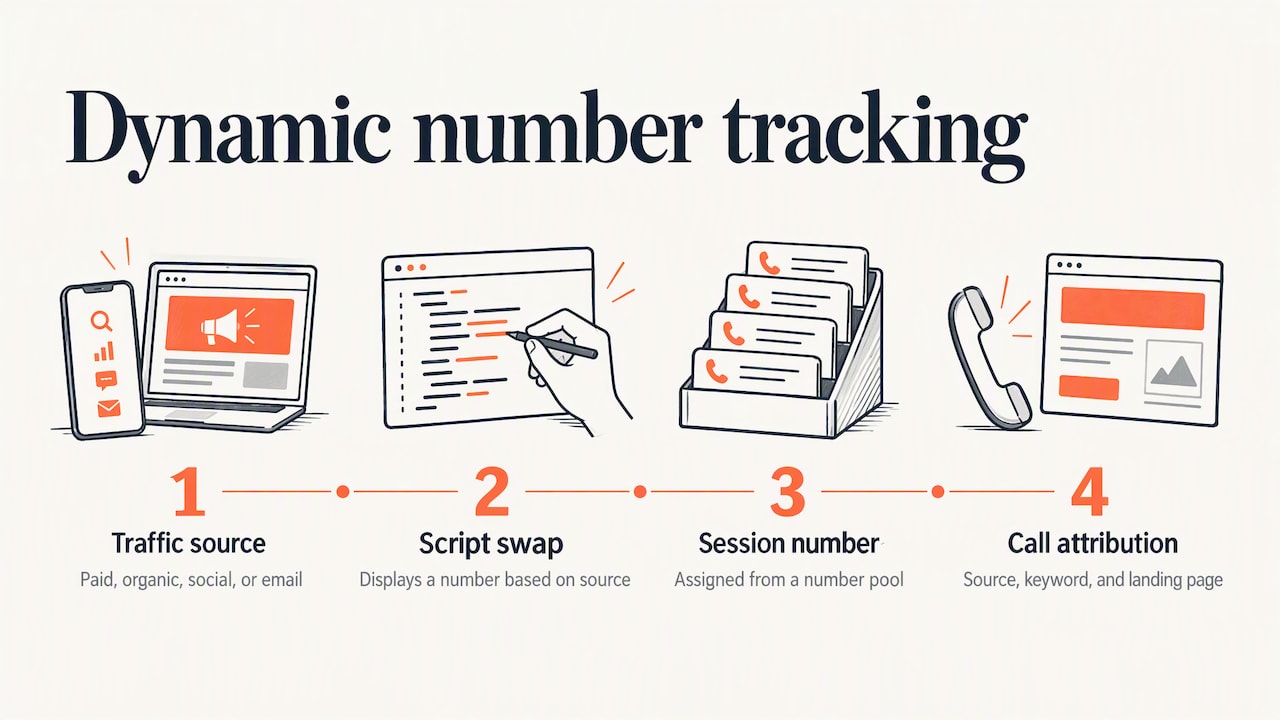
Dynamic numbers work on your website. A short script swaps the phone number a visitor sees depending on how they arrived: paid search, organic search, a social ad, an email link. Each visitor session gets a number from a pool, so a call can be tied to the source, and often to the keyword and landing page, behind that visit.
The pool is where setups fail. Search Engine Land warns that the pool must be large enough for your traffic volume, and that too few numbers can cause attribution errors. If two visitors on different sources see the same number at the same moment, you cannot tell whose call it was.
Calls from ads
There is a third path inside ad platforms themselves. Google Ads can count calls from call assets or call-only ads as conversions, and you set a minimum call length so that only calls lasting at least that long count. It can also track calls to a number on your website after an ad click. This is useful, but it covers only that platform. A dedicated tracking setup shows calls across paid search, social, SEO and offline in one place.
What data a call can give you
A tracked call is more than a tally. Depending on the setup, you can capture:
The source, medium, campaign and sometimes keyword or ad that preceded the call
The landing page the caller was on
The caller’s area code or location, and whether they are a first-time or repeat caller
Time of day, call length and whether the call was answered
Call recordings and transcripts, where legal and enabled
The outcome, once you pass it back from your CRM or mark it manually
Search Engine Land points out that recording and transcription can be optional, and availability may depend on the industry. Recording is not required to get value. Source and outcome data alone change how you spend.
The metrics that show whether campaigns work
The most common mistake is celebrating total calls. A campaign that generates 200 calls from job seekers, wrong numbers and spam is worse than one that generates 30 calls from people ready to hire you. Group your metrics into three layers.
Volume and handling
These tell you whether demand is arriving and whether you are catching it.
Total and unique calls: the raw demand, split by first-time and repeat callers.
Answered and missed calls: every missed call from a paid click is money you spent and lost.
Calls by hour and weekday: shows when to staff the phones and when to schedule ads.
An extensive call metrics reference lists these demand measures, such as answered, missed, voicemail and after-hours calls, among a large set of call KPIs. You do not need 100 metrics. You need a handful you review every month.
Quality
These separate real leads from noise.
Qualified call rate: the share of calls that match your criteria, such as a real case type in your service area.
Call duration: a rough filter. A 15-second call is rarely a lead. Set a threshold that fits your business.
Spam and wrong number rate: a high rate on one campaign suggests a targeting problem.
Appointment or consultation booking rate: the closest call-level proxy for a won customer.
Revenue
These connect calls to money.
Cost per qualified call: ad spend divided by qualified calls, by campaign.
Call-to-customer rate: how many qualified calls become paying clients.
Revenue or return per campaign: requires outcomes passed back from your CRM.
Twilio’s view is that call tracking improves budget decisions by showing which campaigns, keywords and sessions drive revenue instead of merely generating calls. That is the standard to hold your reports to.
A worked example
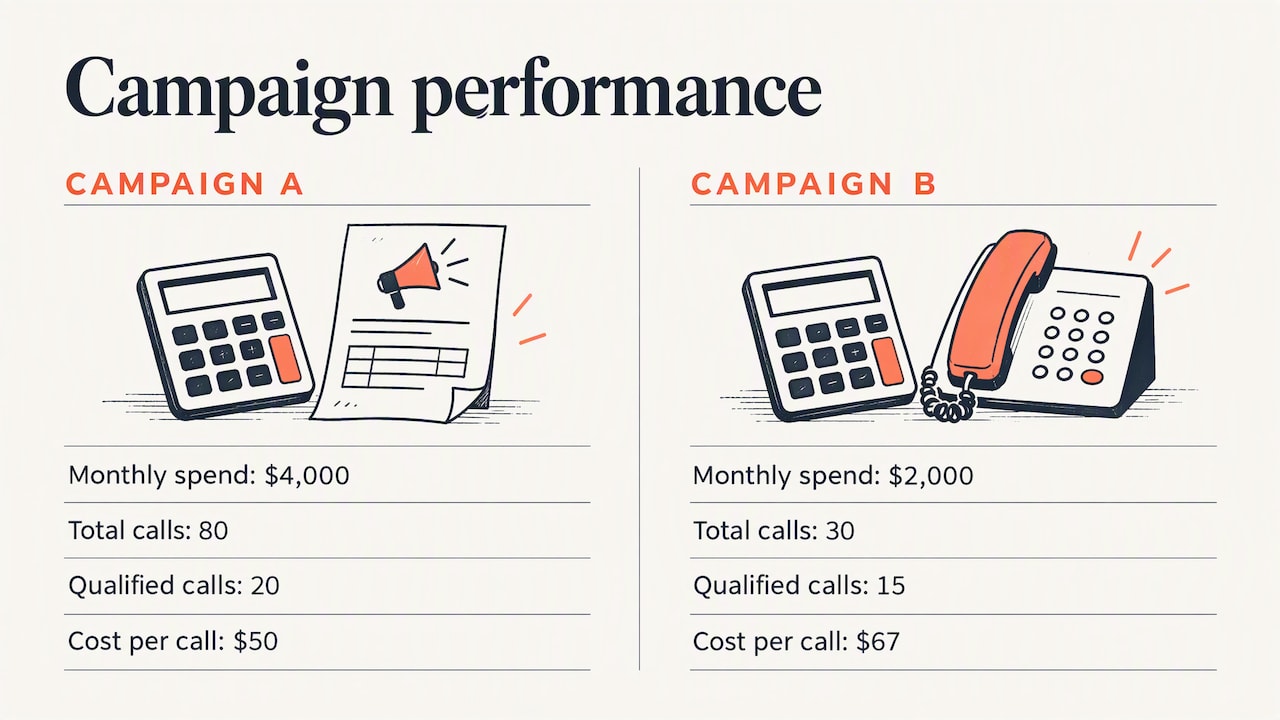
Suppose a law firm spends $6,000 a month across two campaigns. Campaign A costs $4,000 and produces 80 calls, 20 of them qualified. Campaign B costs $2,000 and produces 30 calls, 15 of them qualified. By raw calls, A looks like the winner at $50 a call against $67. By qualified calls, A costs $200 each and B costs about $133. The numbers here are illustrative, but the pattern is real: ranking by total calls can hand your budget to the weaker campaign.
How call tracking improves paid search, SEO and offline ads
Paid search
When calls are tied to keywords, you stop bidding on terms that generate clicks and chatter but no cases. You can raise bids on the queries that produce qualified calls and write ad copy that attracts them. If you are still working out what to spend, our guide to Google Ads costs for a small business covers the budget side.
Organic search
Organic traffic is often credited with fewer conversions than it earns, because so many organic visitors call rather than fill in forms. Tracking calls by landing page shows which articles and service pages bring in phone leads, so you know what to update and what to build next.
Social and display
Facebook and Instagram ads often drive calls on mobile. Without tracking, these calls get lumped into “direct”. With a unique number on the landing page, you see the real return on the campaign.
Offline media
Billboards, print, radio, mailers and vehicle wraps are the classic use for static numbers. One number per medium, or even per mailer drop, shows which placements pay off.
Using call data for lead generation and qualification
Tracking tells you where calls come from. The next step is using that data to get more customers from them. MarTech’s guide to call analytics describes several ways marketers do this:
Route calls by source, geography, demographics, purchase history or intent, so the right person answers.
Give representatives context about the caller before they pick up.
Score calls using conversation data to see which are worth follow-up.
Send call data into CRM systems and nurturing campaigns.
Use what you learn to adjust bids, campaign messaging, creative and audiences.
The same guide notes that call analytics platforms connect calls from websites, social media and click-to-call ads to sales representatives and to the eventual conversion or non-conversion. That last part is the one most teams skip. If outcomes never get recorded, you can measure calls but not customers.
A simple routine works for a small team: each week, mark every call from the past seven days as qualified, unqualified or won. After a month you have enough data to compare campaigns on cost per qualified call and cost per client. This is the same discipline that sits behind our lead generation work.
How to set up call tracking in six steps
Decide what you need to know. Name the decisions the data will drive: which campaigns to fund, which keywords to cut, which offline placements to repeat.
Choose the channels to track. List paid search, social, organic, Google Business Profile, direct mail and anything else that carries a phone number.
Pick static or dynamic per channel. Use static numbers for offline media and profiles. Use dynamic numbers on your website where you need source and keyword detail.
Size the number pool. Base it on your peak concurrent visitors, not your average. An undersized pool is the leading cause of muddled attribution.
Connect your systems. Link call data to your ad accounts, analytics and CRM so conversions and outcomes can flow both ways.
Test before you spend. Visit your site from each source, call the number you see, and confirm the call lands in the right bucket, on the right campaign.
Keep your Google Business Profile and directory listings consistent with your main number or a deliberately chosen tracking number. Mixed numbers across the web can confuse customers and local search signals.
Common mistakes that wreck call attribution
Too few dynamic numbers. As covered above, small pools create attribution errors.
Counting every call as a lead. Without a qualification step, your cost per lead will look better than reality.
Ignoring missed calls. A tracked missed call is a visible loss. Set up voicemail routing, call-backs or after-hours answering.
Never closing the loop. Calls without outcomes only tell half the story.
Tracking calls but not forms. Visitors choose different routes. Compare calls and form fills together for the full lead picture.
Forgetting the legal side. See the next section.
Privacy, consent and recording in the US
Call tracking itself, forwarding numbers and logging metadata, is routine. Recording is where the rules bite. The Federal Trade Commission says that state laws vary on recording telephone conversations, and some states require every party on a call to consent. If you take calls from several states, apply the strictest standard: play a recording notice at the start of the call.
The same FTC guidance explains that the Telemarketing Sales Rule applies to qualifying interstate telemarketing campaigns, including businesses that initiate or receive consumer calls. If you call leads back, for example from a web form, check that your outreach fits the rule and that you screen against the National Do Not Call Registry where it applies.
Law firms carry an extra duty. Calls with prospective clients can contain privileged or sensitive details, so confirm with your bar’s guidance and your counsel how recordings and transcripts should be stored and who can access them. For an overview of how things work outside the US, the UK regulator treats automated marketing calls as needing the recipient’s specific consent, a good reminder that standards differ by country if you market internationally.
This is general information, not legal advice. Before turning on recording, ask your attorney to review your notice wording and retention period.
Our perspective: calls are the conversion most reports miss
We manage paid media for law firms, municipalities and local businesses, and one pattern shows up again and again. A client sees a modest number of form fills, concludes a campaign is underperforming, and meanwhile the phones have been ringing. Search ads for services people urgently need, such as a lawyer after a visa denial or a contractor after a storm, produce calls first and forms second.
Our view is that a campaign is only as good as the picture of results behind it. We have managed over $3.2 million in ad spend and have delivered a 10x return on ad spend for clients, and every one of those decisions depended on clear reporting. Tracking calls is part of that clarity: it keeps budget with the campaigns that produce real inquiries, and it stops you cutting what works.
We also think the phone number is a design problem, not just a tracking problem. If the number is buried in a footer or the click-to-call button is missing on mobile, no tracking setup can rescue the page. That is why we build the website and the ad campaign together: conversion-ready design on the front, honest numbers on the back. For a sense of what that looks like, see how one search campaign turned 6,252 views into 124 leads and an immigration law campaign that drove 63 leads.
— User
Where Media Click AI fits
If you want phone leads that you can trace back to spend, we can help with the parts that make tracking useful: Google and Meta campaigns, conversion-focused websites with prominent click-to-call, and analytics and reporting that show what each campaign delivers. Pricing is scoped per project, so there is no published rate card. Take a look at our paid media and web design services, or talk to us about a campaign built around calls. If you are weighing the value of ads first, why paid media matters is a good place to start.
Choosing a call tracking approach
You do not need to pick a vendor to decide what you need. Work through these criteria:
Question | If yes | If no |
|---|---|---|
Do most of your customers call before they contact you any other way? | Prioritize dynamic numbers and call outcomes | Start with static numbers on key channels |
Do you run offline media? | Add a unique static number per medium | Focus on web sources |
Do you need keyword-level data? | Use dynamic number insertion with a large pool | Campaign-level static numbers may do |
Do you take calls about sensitive matters? | Limit recording, review retention with counsel | Recording and transcripts can add coaching value |
Do you use a CRM? | Pass call outcomes back for revenue reporting | Log outcomes in a shared sheet each week |
Tools in this category range from simple number-forwarding services to full conversation analytics platforms. Match the tool to your question list, your call volume and your team’s capacity to act on the data. A basic setup you review every week beats an advanced one nobody opens.
FAQ
What is call tracking in marketing?
Call tracking uses unique phone numbers to identify which ad, keyword, page or campaign led to an inbound call. It forwards calls to your normal line while logging source and call details. The result is phone leads that appear in your marketing reports alongside clicks and form fills.
Do I need dynamic or static numbers?
Use static numbers for offline media and single-channel placements such as a billboard or a business listing. Use dynamic numbers on your website when you want to know the source or keyword behind each call. Most businesses end up with both.
Is call tracking legal?
Tracking the source of calls is common practice. Recording is regulated, and the FTC notes that state laws on recording conversations differ, so play a notice and get consent where required. For regulated professions such as law, have counsel review your recording and storage practices.
Which metrics should I watch first?
Start with qualified calls, cost per qualified call, answer rate and call duration. Add call-to-customer rate once you record outcomes. These show whether a campaign brings real business, not just ringing phones.